


A new resource index aims offers support for primary care clinicians diagnosing dementia
Diagnosing dementia is hard. Early cognitive changes can be subtle, and it’s a difficult subject for clinicians to bring up with their patients. For primary care clinicians, short appointment times and ever-growing to-do lists make recognizing the need and initiating these conversations even more challenging.
Over the years, many resources have been created to help clinicians develop the skills and confidence needed to lead these conversations. But each tool varies in its approach and organization, and for busy clinicians, just finding the resource they need in the moment can be a daunting task.
The Index of Primary Care Clinical Resources for Dementia
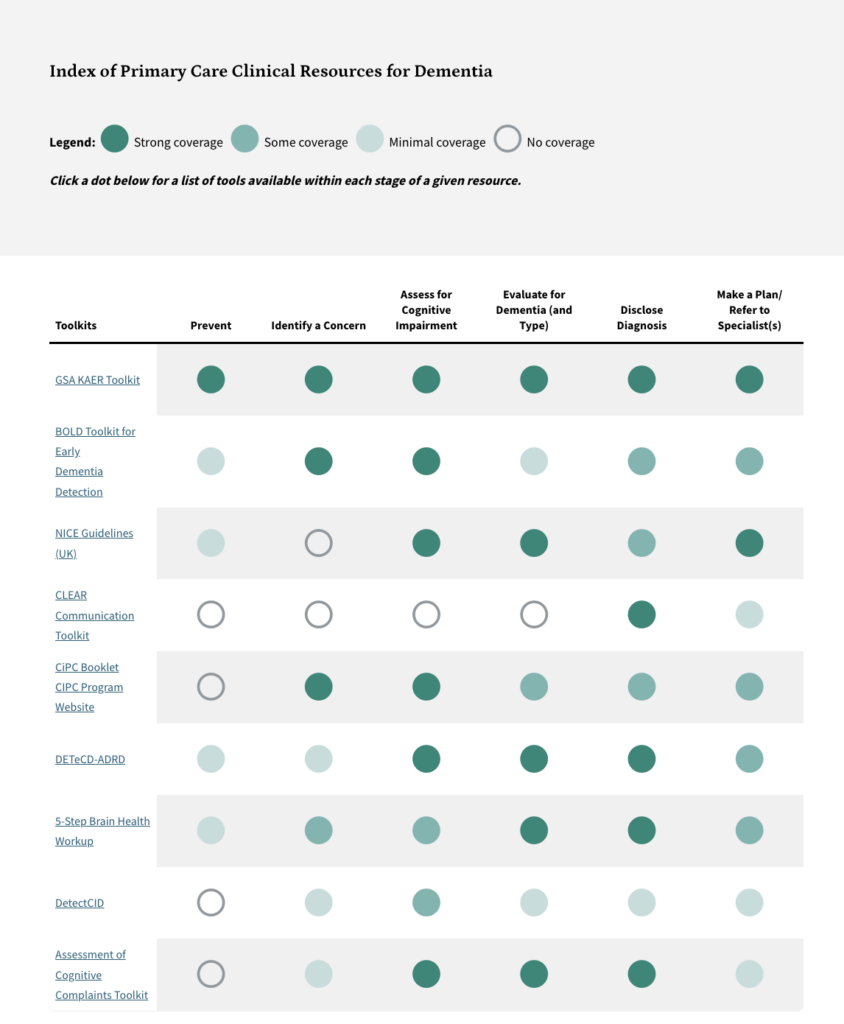
The Essential Communications for Dementia team at Ariadne Labs has created the Index of Primary Care Clinical Resources for Dementia to help clinicians navigate the available resources and find the right support for their specific needs. The Index outlines nine existing toolkits for diagnosing and discussing dementia in primary care. It provides a snapshot of what stage of diagnosis each toolkit may be most useful for and what types of tools and resources each one contains, including point-of-care resources.
“As we began to look at the landscape of the available resources, we realized the problem wasn’t just a lack of tools. It was partially that there were an overwhelming number of tools, each with a different focus,” said Bruce Finke, MD, a Senior Advisor for Primary Care at Ariadne Labs. “Clinicians are already overwhelmed. We wanted to make it easier to sort through and use what’s out there so they can spend their limited time learning from and using the tools that are available, not wading through information.”
The Index is not intended to be a comprehensive catalog; rather, it’s meant to serve as a starting point for clinicians trying to quickly find something that will help them in the moment, whether that’s suggested language for starting a conversation or detailed information about evaluating patients for different types of dementia. The toolkit intentionally does not evaluate the quality or utility of each toolkit so that each clinician can decide what’s most useful for their specific needs.
Designing New Tools to Fill the Gaps
While the Index itself helps to fill a need, it has also helped highlight where gaps still remain in the kind of support clinicians can find. In particular, the team found opportunities to build upon existing point-of-care tools and integrate them more fully into clinical practice.
“The Index started as background research. We didn’t plan to publish it, but as we learned more, we saw that it could be a helpful, real-time tool for busy clinicians,” said Laura Frain, MD, Associate Faculty at Ariadne Labs and a Geriatrician at Brigham and Women’s Hospital in Boston. “Now, we are excited to use what we’ve learned in creating the Index to develop additional resources that will offer clinicians more comprehensive support.”
Our multidisciplinary team of clinicians, designers, researchers, and other experts is designing and testing new tools that support primary care clinicians in having the necessary but difficult conversations with patients and families throughout the process of dementia diagnosis. These tools are intended to be quick and easy to use with patients in the moment and will include meaningful guidance to clinicians throughout the entire conversation, including what to do at points where clinicians or patients often feel stuck.
“In doing this work, we’ve talked to a lot of clinicians about the struggles they face in diagnosing dementia. It’s a process that takes time over more than one visit and doesn’t have a single, clear diagnostic test. It’s ambiguous,” said Joshua Lakin, MD, a palliative care physician and faculty for Ariadne Labs’ Navigating Aging and Illness Program. “The patient is coping with a threat to their sense of self, the clinician to their role as a healer, and caregivers to their sense of partnership.”
The goal of the Essential Communications for Dementia project is to make it easier for clinicians to initiate clear, empathic conversations about dementia at an earlier stage and provide meaningful, person-centered treatment and support as the needs of patients and their care partners shift throughout the course of the disease. Our hope is to build practical tools to improve the care experience for clinicians, patients, and care partners, and give people the opportunity to live well throughout their dementia journey.