



The Cesarean Safety Checklist was designed to strengthen teamwork, evidence-based practices, and respectful care for women and newborns during cesarean birth
The Challenge
Cesarean birth is the most common surgery worldwide, accounting for more than 21% of all births. In India, the percentage is even higher: 27% of births are by cesarean, with some regions reaching nearly 40%. Complications during cesarean birth can cause serious harm to women and newborns and are often driven by gaps in evidence-based practices, unclear internal processes, breakdowns in team communication and teamwork, and insufficient safety culture.
While the WHO Surgical Safety and Safe Childbirth Checklists have improved outcomes for surgical procedures and in childbirth, respectively, the unique features of cesarean birth remain a gap between the two Checklists.
Our Solution: The Cesarean Safety Checklist

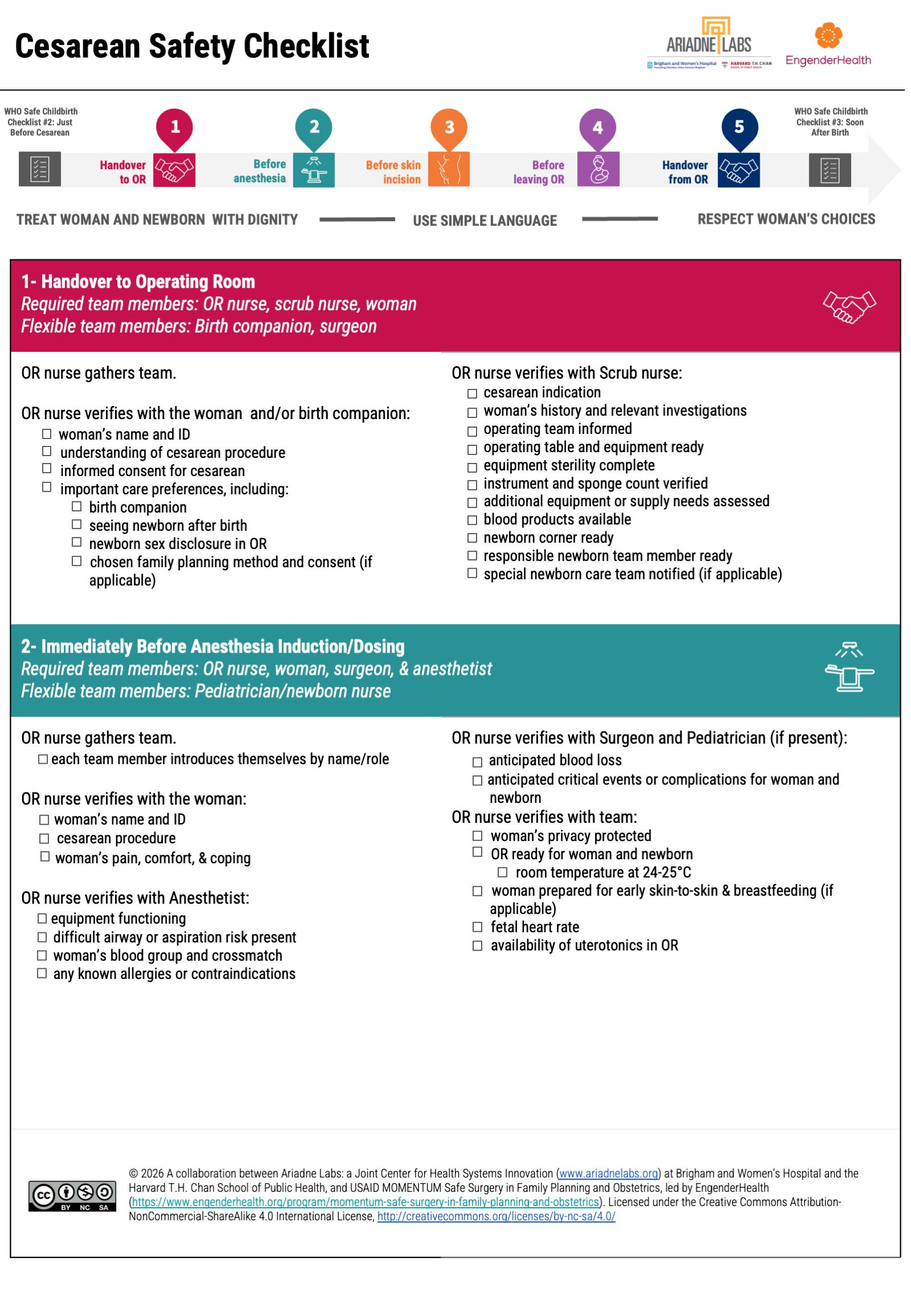
Together with EngenderHealth, Ariadne Labs developed the Cesarean Safety Checklist to strengthen teamwork, reliable evidence-based care, and respectful care for women and newborns during cesarean birth. The Checklist includes a structured set of five key pause points spanning preparation to enter the OR to completion of the procedure to preparation to move to the postnatal floor. The Checklist is accompanied by implementation guidance, training materials, and coaching resources to support its use. It is designed to replace the WHO Surgical Safety Checklist for cesarean births and complements the WHO Safe Childbirth Checklist.
Download the Checklist
Cesarean Safety Checklist
Download the editable Cesarean Safety Checklist for adaptation and use in your clinical setting.
Download the ChecklistIn a pilot test at three hospitals in India, the Checklist was successfully integrated into routine cesarean care. Surgical teams found it usable, feasible, and acceptable, and women valued their communication with staff and their involvement in decision-making as a result of the prompts in the Checklist.
Future work will continue to test and refine the Checklist, with the goal of evaluating both implementation and clinical outcomes in a variety of settings.