

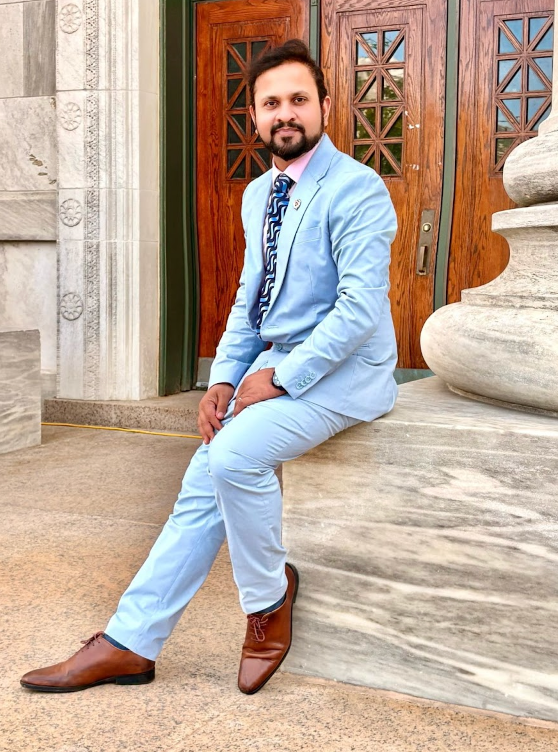
Saravanan Thangarajan, MDS, MMSc, MBA, is the 3rd Home Hospital International Fellow. Dr. Thangarajan is a global health leader who builds systems where equity and innovation meet, bridging science, policy, and technology to expand access to quality care in low-resource settings. Over the past decade, Dr. Thangarajan has led reforms bringing advanced, equitable care to communities often left behind. Learn more about Dr. Thangarajan’s background here.
How did you get started working in home health care?
My work in home health care started during the COVID-19 pandemic. I was working in a government leadership role in Tamil Nadu, India, leading programs in maternal and child health, mental health, disaster preparedness, and emergency medical services. When the COVID-19 crisis began, I quickly transitioned into population-level public health leadership, coordinating pandemic response for a population of over 7.8 million people.
During lockdowns, we saw clearly that access was a major barrier to care. Patients with chronic conditions, pregnant women, and others simply could not get to hospitals. In response, I played a central role in designing and implementing “Makkalai Thedi Maruthuvam” (Healthcare at People’s Doorsteps), a statewide home health program launched in 2022. We trained and deployed frontline health workers to deliver care in patients’ homes to reduce the need to travel to facilities and improve access across rural and underserved communities. That experience reshaped how I think about care delivery. I now see home-based care not as a stopgap, but as a core pillar of resilient health systems, particularly in settings where geography, workforce constraints, and infrastructure limit traditional hospital access.
What got you interested in the Fellowship?
Tamil Nadu is one of India’s stronger state health systems. Yet even within this context, we continued to face persistent challenges around last-mile access, community trust, and logistics, especially for patients who could not reach facilities. That gap pushed me to look at how other health systems were addressing similar challenges.
This led me to David Levine’s work on acute care at home and the broader efforts at Ariadne Labs. What stood out was not only the clinical model, but the rigor around implementation, protocols, and evidence generation within a complex health system. In Tamil Nadu, home-based care emerged out of necessity. The Ariadne model showed what it could look like when designed intentionally for scale, evaluation, and sustainability.
Coming from a public health system operating at scale, I saw an opportunity to contribute practical implementation perspectives while learning from a mature, evidence-driven approach to home hospital care. TheFellowship felt like a natural fit. At its core, this work matters to me because access to care should not depend on a patient’s ability to reach a hospital.
What are you focused on during your time as a Fellow?
During my fellowship, I’m supporting the team across several areas where my experience in public health systems and rural care delivery is most relevant. A central focus of my time so far has been working on a protocol paper for the DEMOCRATIZE project, where we’re designing and testing models of delivering care to rural communities using mobile vans.
Within the DEMOCRATIZE project, I’ve also been working alongside the team as we collectively explore how augmented reality can be used as part of this care model to remotely supervise clinicians who are not physically co-located.
I’ve also been collaborating with the team to review existing training materials for up-skilling the medical assistants who deliver care in the field and to identify opportunities to strengthen preparation and ongoing support.
The fellowship has been a shared learning process. I’m gaining insight into how these models are being built and tested within a U.S. health system, while contributing perspectives from large-scale rural and public health programs.
What do you hope to take away from the Fellowship?
I want to deepen my understanding of how home hospital models are designed, tested, and evaluated, particularly the clinical protocols, operational decisions, and technology choices that allow them to function at scale. My goal is to identify elements that translate across contexts and adapt them thoughtfully to public health and rural health systems in India. I’m especially interested in how these approaches address access gaps in rural settings. Those challenges are not unique to the U.S.; they appear globally.
Beyond specific tools or technologies, I want to understand the underlying logic of the model: how decisions are made, how safety is maintained when care moves out of hospitals, and how systems remain accountable. That perspective will inform future pilots and policy discussions at home, with the aim of building models that are locally grounded, scalable, and resilient.
Any advice for future fellows?
Spend time with people, not just projects. Conversations across the team are where the work starts to make sense. Everyone brings a different perspective and is often balancing multiple streams of work, and those informal exchanges are where you begin to understand how the system actually functions. Ask questions early, listen closely, and pay attention to how decisions are made across disciplines. The real value of the fellowship comes less from observing a single project and more from engaging with the people building the work together.